
Learn how Lifeline eligibility, state rules, providers, documents and phone offers work together.
If you are thinking, “Just tell me what I can actually get,” this guide gives you the practical answer.
Use the tables and checklists below before choosing a carrier or uploading personal documents.
How the free government phone system actually works
A “free government phone” normally combines a federal Lifeline discount with a separate device promotion from a participating company.
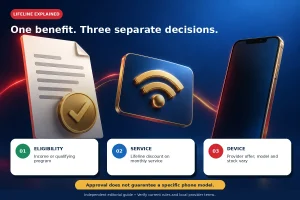
The first layer is eligibility. USAC administers Lifeline for the Federal Communications Commission and verifies whether your household qualifies. The second layer is service. A participating company applies the benefit to an eligible phone, internet or bundled plan.
The standard federal discount is up to $9.25 per month. On qualifying Tribal lands, the enhanced discount can reach $34.25 per month. These amounts support service. They do not guarantee an iPhone or any particular handset.
The third layer is the provider’s phone offer. One company may include a basic smartphone. Another may offer a refurbished premium model, a discounted upgrade or bring-your-own-device service. Inventory and terms can change after an advertisement is published.
✅ Simple rule: Lifeline determines whether help is available. The carrier determines the plan and any device promotion.
“But I saw a free iPhone.” That offer may exist for a specific ZIP code or limited inventory. Confirm model, condition, shipping and final cost after eligibility. ACP is not an alternative route because the Affordable Connectivity Program has ended.
Free government phone eligibility and income limits
You qualify through one accepted assistance program or household income at or below 135% of the federal poverty guidelines.
| Household | 48 states, D.C. | Alaska | Hawaii |
|---|---|---|---|
| 1 person | $21,546 | $26,933 | $24,786 |
| 2 people | $29,214 | $36,518 | $33,602 |
| 3 people | $36,882 | $46,103 | $42,417 |
| 4 people | $44,550 | $55,688 | $51,233 |
For each person above eight, add $7,668 in the contiguous states, $9,585 in Alaska or $8,816 in Hawaii. The table is updated annually, so older articles can contain obsolete limits.
Accepted programs include Medicaid, SNAP, Supplemental Security Income, Federal Public Housing Assistance, Veterans Pension and Survivors Benefit. Qualifying Tribal programs include BIA General Assistance, Tribal TANF, qualifying Head Start and FDPIR.
Age 65 and Medicare alone do not qualify someone. A senior often qualifies through Medicaid, SSI, SNAP, a veterans benefit or income. A child or dependent’s program participation can establish household eligibility.
Survivors covered by the Safe Connections Act have an emergency route lasting up to six months. Expanded criteria can include income at 200% of the guidelines, WIC, school meals or a current Pell Grant, together with evidence of a legitimate line-separation request.
What changes by state when you apply for Lifeline
The federal core stays consistent, but the application administrator, added benefits, provider footprint and device inventory vary by state and ZIP code.
New York and Pennsylvania: applicants generally use the National Verifier, then choose a company serving their address. New York City and Philadelphia do not create separate city eligibility rules. The variable is provider coverage and inventory.
Texas: Lifeline Support directs residents to the state application route. Houston applicants should confirm Texas approval first and then compare carriers by address.
Oregon: residents also follow a state-specific route. A generic national application link may omit a required local step.
California: California LifeLine has its own approval framework and state-supported enhancements. Assurance Wireless says eligible California customers can receive phones through designated vendors, while other markets may emphasize low-cost devices or BYOD.
Alaska and Hawaii: income limits are higher. Qualifying Tribal lands can also unlock the enhanced federal benefit.
Lifeline phone providers, plans and device offers
Compare at least two providers because service, network, support and phone terms can differ even inside the same city.
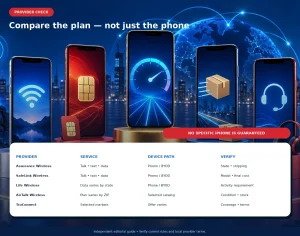
Assurance Wireless advertises free talk, text and high-speed data on the T-Mobile network. Current materials show state-specific data and device offers, including free phones for eligible California customers, low-cost options and BYOD.
SafeLink Wireless advertises free monthly talk, text and data. Its separate authorized store sells Motorola, Samsung and Apple devices, so free service should not be confused with a guaranteed premium handset.
Life Wireless advertises unlimited talk and text, high-speed data, activation and nationwide 5G where available. Data varies by state. Customers may bring a phone or obtain a new smartphone and must show qualifying account use during each 30-day period.
AirTalk Wireless advertises up to 10GB, unlimited talk and text, international calling and state-dependent devices. Its researched catalog displayed selected older Apple, Samsung, TCL and other models at $0, subject to ZIP, eligibility, condition and inventory.
TruConnect serves selected markets, including California LifeLine. Verify its local plan and device before enrolling. Use the official Companies Near Me lookup to find every eligible carrier serving your area.
Ask: Is the phone new or refurbished? Is shipping free? How much high-speed data is included? Is hotspot supported? Can I keep my number? Which network is used? What happens after the data allowance? What is the warranty and replacement policy?
Network ownership matters because most Lifeline companies are mobile virtual network operators. They use a larger carrier’s network but manage enrollment, customer care and plan rules themselves. A provider using a familiar network can still have different data priority, support hours and replacement policies from the network owner’s retail service.
Separate the initial device from the monthly plan. A phone may arrive at no charge while replacements and upgrades are paid. Conversely, a company may offer excellent free monthly service but require you to bring or buy a compatible unlocked handset. Neither structure is automatically better.
⚠️ Premium phone reality: an iPhone shown at $0 may be older, refurbished, limited by state or unavailable after approval.
Documents required for Lifeline verification
The verifier may request separate proof of identity, address and eligibility, and every document must contain matching information.
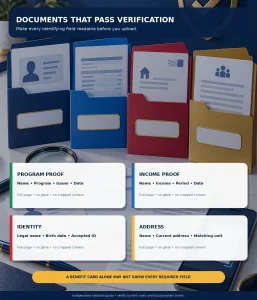
Program proof should show your name or dependent’s name, the program, issuing agency and a date within 12 months or future expiration. Use an award letter, benefit statement, verification letter or benefits portal screenshot.
Income proof must show the name, annual income and a current issue date. Examples include a prior-year tax return, employer statement, Social Security statement, unemployment or workers’ compensation statement, divorce decree or child support award.
When annual income is not shown, three consecutive months of current pay stubs may be accepted. Random nonconsecutive stubs create an avoidable verification problem.
Identity evidence can include an unexpired driver’s license, passport, government or Tribal ID, birth certificate, naturalization certificate or permanent resident card. SSN proof can include a Social Security card, W-2, SSA-1099 or tax return showing the last four digits.
Address proof can include a government ID, utility bill other than the internet company, lease, mortgage statement, W-2 or tax return. Applicants without a conventional address can use mapping information; Tribal land applicants may need coordinates.
“My daughter receives Medicaid, but I need the phone.” That can be valid because a dependent’s participation may qualify the household. “Another adult here already has Lifeline.” Complete the household worksheet and prove you do not share income and expenses.
Detailed step-by-step Lifeline application process
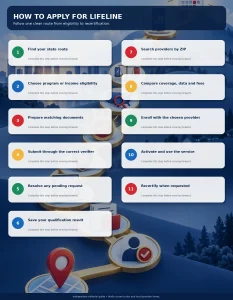
Choose the state route first, prove eligibility second and select a provider only after reviewing the actual plan and phone.
- 1Confirm your state route. Texas and Oregon use state-specific processes.
- 2Select one qualification path. Use a program or income, not both.
- 3Match your records. Use the same legal name, birth date and address everywhere.
- 4Submit clear proof. Upload documents only when automatic verification fails.
- 5Save the decision. Keep the application reference and approval notice.
- 6Compare carriers by ZIP. Confirm network, plan, phone condition, fees and delivery.
- 7Activate and use service. Follow usage rules and recertify annually when requested.
Keep screenshots of the selected device and plan. If inventory changes before shipping, your records clarify whether the carrier substituted the phone or changed the terms.
Before activation, back up contacts and photos from an old phone. If you want to keep your number, do not cancel the old line first. Ask the new provider to complete the number transfer and confirm which account number and transfer PIN are required.
After activation, test calling, texting, mobile data, voicemail and emergency calling from the locations that matter most. Save customer-service numbers somewhere outside the phone in case the device stops working.
Application problems and frequently asked questions
Most delays come from mismatched records, incomplete proof, household duplication or choosing a carrier before eligibility is resolved.
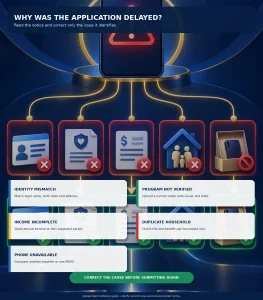
If identity fails, compare spelling, suffixes, apartment numbers and dates across your application and ID. If program participation fails, request a current letter naming both participant and program. An EBT card may not show every required field.
If income proof fails, confirm the correct person, annual income or three consecutive months, and an accepted date. If another benefit appears at your address, use the household worksheet when residents do not share money.
If a phone disappears from inventory, your eligibility may remain valid. Compare another carrier or BYOD service. Do not create a false household application to chase a model.
Use the service at least once during required activity periods. Report a move, loss of eligibility or duplicate benefit within 30 days. Missing recertification can terminate the discount or increase the bill.
Can I apply again after a denial?
Yes, after correcting the reason for denial. Review the notice, update mismatched information and submit the specific proof requested instead of repeating the same application.
Can I switch Lifeline providers?
Yes. Contact the new company and request a benefit transfer. You may need to reverify eligibility, and any promotional phone from the old provider does not guarantee another free device.
Can I keep my current phone number?
Many providers support number transfers. Keep the old service active until the port finishes and obtain the account number and transfer PIN from the previous carrier.
Does approval guarantee the advertised phone?
No. Approval establishes Lifeline eligibility. Device model, condition and availability remain subject to the provider’s local offer and inventory.
How to choose a free phone offer safely
The best offer is the one whose coverage, data, phone condition and support remain useful after the excitement of “free” disappears.
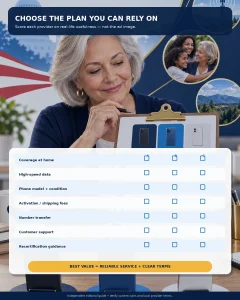
Start with coverage at home, around your neighborhood and along regular routes. Then compare high-speed data, hotspot access and reduced-speed rules. “Unlimited” does not always mean unlimited high-speed data.
Ask for the exact phone model, storage, condition, warranty and return policy. An older refurbished iPhone can be useful, but it should not be presented as a new current-generation device.
For someone in New York, Philadelphia or Houston, the emotional goal is similar: “I want a phone I can trust for family, appointments and emergencies.” The technical answer depends on state route, ZIP coverage and provider inventory.
Give each provider one point for acceptable coverage, enough data, clear device condition, no unexpected fees and reachable support. The highest advertised retail value should not automatically win.
ℹ️ Important: CDIN is an independent, advertising-supported information site. It is not a government agency or Lifeline provider. Verify current rules with USAC, the state administrator and selected carrier.