Roof replacement costs $9,600 on average today, and this guide shows what that number really covers.
You will see the price by material, when insurance actually pays, and the real programs that can lower your bill.
Keep reading before you sign any quote, since one number in this guide can save you thousands.
How much does roof replacement cost
A full roof replacement averages $9,608 nationally, according to Angi’s cost guide, with HomeAdvisor reporting the same $9,607 average from its own contractor data.
| Material | Total cost range |
|---|---|
| Asphalt 3-tab | $5,800 to $20,000 (15 to 20 yrs) |
| Architectural shingles | $6,000 to $12,000 (20 to 30 yrs) |
| Flat or rubber | $4,000 to $16,800 (15 to 30 yrs) |
| Metal | $5,700 to $25,000 (40 to 80 yrs) |
| Clay or concrete tile | $8,500 to $26,400 (50 to 100 yrs) |
| Slate | $5,800 to $30,000 (60 to 150 yrs) |
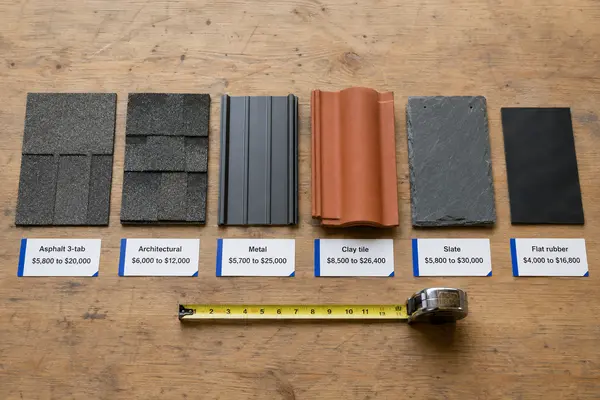
Ranges come from Fixr’s material guide; asphalt shingles remain the choice on about 4 out of 5 US homes because they balance price and lifespan. This Old House puts a 2,000 square foot asphalt roof at $15,439 installed, while HomeGuide and Forbes Home report averages of $10,800 and $11,500. Tear-off of the old roof adds $1 to $5 per square foot, and labor typically runs 60 percent of the total bill, according to Angi.
Regional pricing swings the number further: coastal and high wind-code areas often run 15 to 30 percent above the national average because of stricter material and fastening requirements. A roof over a garage or a simple single story home lands near the low end; steep pitches, multiple layers to remove, and chimneys or skylights push a quote toward the high end.
A number this size rarely arrives without pressure attached, which is exactly what the next section walks through.
See if you qualify for USDA home repair help
What an $18,000 quote means on a fixed income
An $18,000 quote can feel like a closed door when your income is under $28,000 a year, but the real market price is usually lower.
Take Donna, 58, who lives alone in the house she has owned for decades. A storm knocks loose shingles off her roof, and the first contractor who knocks on her door quotes $18,000 with a same-day discount if she signs before he leaves. She almost does, since the ceiling stain in her spare room is getting bigger every week.
Instead, she calls her insurance agent and two more roofers. Her policy covers replacement cost value, not the lower actual cash value some older policies pay, so her real out-of-pocket cost after the deductible turns out to be far less than $18,000. The other two roofers quote $8,600 and $9,900 for the same architectural shingle job, both close to the $9,608 national average.
Donna does not need to accept the first number a stranger writes on a clipboard. She needs her policy type, a written scope of work, and one more quote, and that is exactly what the rest of this guide gives her.
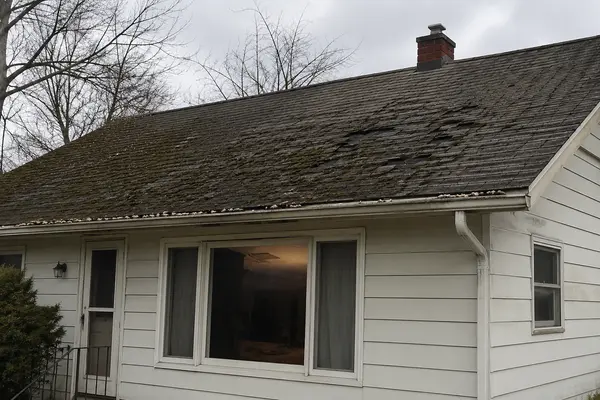
Signs you need a new roof, not a patch
Seven signs point to full roof replacement instead of a spot repair, and a roofing inspector checks for all seven in about twenty minutes.
Roofing manufacturer GAF uses a simple rule contractors call the 25 percent rule: if damage covers more than a quarter of the roof, replacement is usually more cost effective than repeated repairs. Asphalt shingle roofs typically last 15 to 30 years depending on the shingle grade, while metal can reach 40 to 80 years and slate can pass a century.
A single missing shingle after a storm does not always mean a full replacement. A licensed roofer can patch an isolated spot on an otherwise sound roof for a fraction of the cost, so get an inspection before assuming the worst.
Knowing you need a new roof is only half the problem. The next section covers who actually pays for it.
When insurance pays, and real programs that help
Insurance pays for roof replacement only when the damage comes from a covered event like a storm, hail or fire, not from ordinary age and wear.
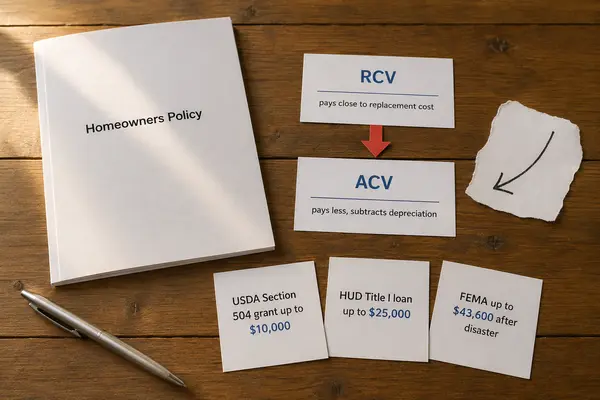
Two very different numbers can come out of the same claim. The National Association of Insurance Commissioners uses an example of $15,000 in storm damage that pays out at $14,000 under a replacement cost value, or RCV, policy, but only $4,000 under an actual cash value, or ACV, policy that subtracts depreciation for the roof’s age. Read your policy’s declarations page before you file a claim, since that one line decides whether you owe thousands more.
Note: the Weatherization Assistance Program does not cover roof replacement, per Department of Energy guidance WPN 19-5, even though it helps with windows and insulation. Do not count on that program for a roof.
No program hands a new roof to everyone who applies, and each one has its own income limit, location rule or disaster requirement, so confirm eligibility before you count on any single source.
How to start your roof replacement
Six steps take you from a leaking ceiling to a signed, fair priced contract.
- 1Photograph the damage from the ground and, if safe, the attic, before anyone touches the roof.
- 2Check your policy type, RCV or ACV, before you call your insurance company to file a claim.
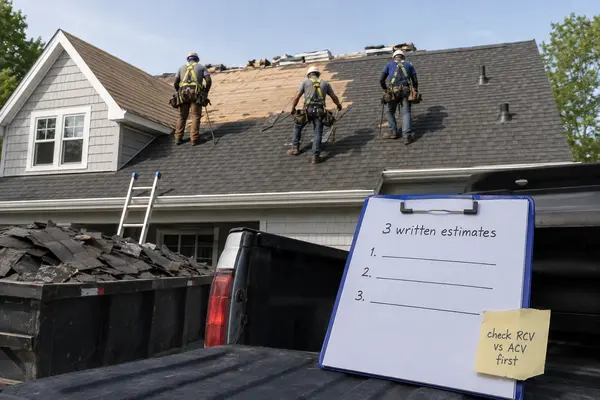
- 3Get three written estimates from local licensed roofers, not just the one who knocked on your door.
- 4Compare material, tear-off and disposal line by line instead of the bottom line number alone.
- 5Check for assistance programs before you sign, using the list in this guide.
- 6Verify the contractor’s license and insurance before any deposit changes hands.
A common mistake is signing a same-day discount offer from a door-to-door contractor after a storm. Take every quote home, sleep on it, and check the license number with your state’s contractor board before you pay a deposit.
Roof replacement FAQ
Six questions homeowners ask most often before they hire a roofer.
How much does a new roof cost on average?
The national average is $9,608, according to Angi, with most homeowners paying between $5,700 and $12,900 depending on size and material. HomeAdvisor reports a nearly identical $9,607 average.
Does homeowners insurance cover roof replacement?
Only when a covered event like a storm, hail or fire caused the damage, and only up to your policy’s actual cash value or replacement cost value terms. Ordinary aging is not a covered cause.
What is the difference between RCV and ACV?
RCV pays close to the full cost of a new roof. ACV subtracts depreciation for your roof’s age first, which can cut the payout by thousands on an older roof.
Can I get a free roof from the government?
No program gives a free roof to everyone. USDA, HUD and FEMA programs each have income, location or disaster requirements, and the Weatherization Assistance Program does not cover roofs at all.
How long does a roof replacement take?
Most single family homes take one to three days for a full tear-off and reroof, weather permitting. Metal, tile or slate roofs can take longer because of the specialized installation.
How long does a new roof last?
Asphalt shingles typically last 15 to 30 years depending on the grade. Metal roofs can reach 40 to 80 years, and slate or tile roofs can pass 100 years with proper maintenance.
More help on CDIN
CDIN exists to translate programs like these into plain language, and a roof is one line item on a longer list for homeowners on a tight budget.
If a roof is only one item on a longer repair list, start with our guide to government home repair grants, which covers the same USDA and HUD programs in more detail. If a high utility bill is adding pressure on top of a roof repair, see LIHEAP energy bill assistance, a separate federal program for heating and cooling costs. For a broader look at what else you may qualify for, see our overview of how to apply for government grants.
Your next step
Check your attic today for daylight, water stains or sagging boards, and photograph anything you find.
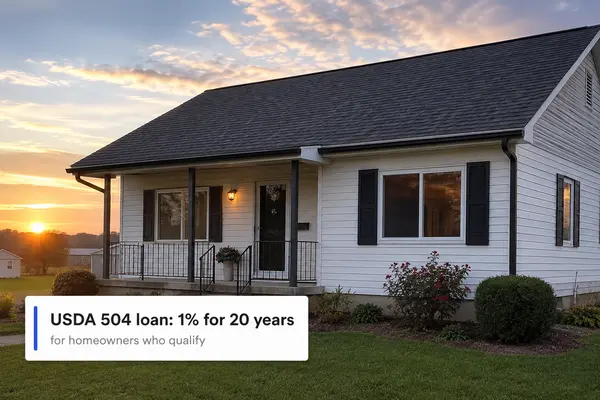
Then check your insurance policy type and call your state’s USDA Rural Development office before you sign any contractor’s quote. That order alone can be the difference between paying $18,000 and paying closer to $9,000.
Check your USDA repair loan eligibility
Important: this content is informative and independent. CDIN has no relationship, sponsorship or control over the companies and agencies named here. Values and rules can change, so confirm details on the official channels before you sign anything.