The Workforce Pell Grant pays up to $7,395 for short job training programs.
No degree needed. Nothing to pay back. Training can take as little as 8 weeks.
See how to apply, which careers qualify and what other aid you can stack.

How to apply for the Workforce Pell Grant
You apply through StudentAid.gov, the official federal financial aid website, and it costs nothing. The entire process starts with one form called the FAFSA (the Free Application for Federal Student Aid).
The FAFSA is the same application used for every federal grant, student loan and work-study program. Filling it out once opens the door to all of them. After you open the official page, follow these steps in order.
1Fill out the FAFSA form
Go to StudentAid.gov and complete the FAFSA. It is 100% free and asks about your income and family size. This single form decides how much federal financial aid you can receive.
2Find an approved program in your state
Each state approves its own list of trade school and community college programs. Check your state’s higher education or workforce website for a list called “Workforce Pell eligible programs”.
3Talk to the school’s financial aid office
Before enrolling, ask one direct question: “Is this program approved for Workforce Pell?” The financial aid office also knows about scholarships and tuition assistance you can add on top.
4Enroll and let the school confirm your aid
Once you are accepted, the school marks your record as “Enrolled in Eligible Workforce Program”. The grant money is then applied to your tuition. You never pay it back.
What is the Workforce Pell Grant
The Workforce Pell Grant is a new type of federal financial aid that pays for short career training. It became available on July 1, 2026, after being created by a law signed in July 2025.
For over 50 years, the regular Pell Grant only covered college degree programs lasting 16 weeks or more. That left out millions of people who wanted vocational training instead of a four-year online degree or campus program.
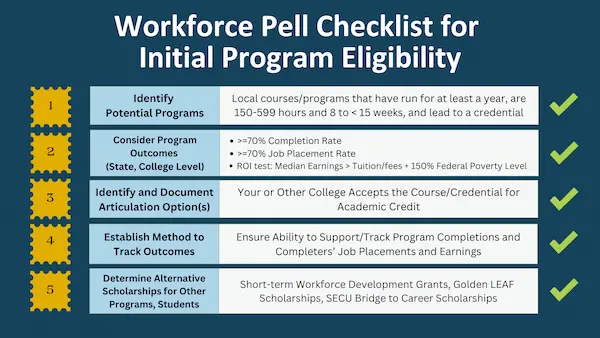
The new version changes the rules. The government can now help pay for accredited programs that last 8 to 15 weeks (150 to 599 hours of instruction). These are hands-on courses at trade schools, technical colleges and community colleges.
The goal is simple: train people fast for jobs that pay well and need workers now. Career training programs in healthcare, skilled trades, transportation and IT sit at the center of the plan.
Unlike a private student loan, this money carries no interest and no monthly payment. It works exactly like a scholarship: the aid goes to the school, reduces your tuition and disappears from your life as a debt. That difference alone can save a student thousands of dollars.
How much money you can get
The maximum award is $7,395, the same top value as the regular Pell Grant. The exact amount you receive depends on two things: your financial need and the length of your program.
Shorter programs receive a smaller share of the maximum. A 15-week HVAC certification course can qualify for more aid than an 8-week certificate. Your income, reported on the FAFSA, also shapes the final number.
To give you a sense of scale, average community college tuition runs around $4,000 per year at public two-year schools. That means the grant can cover the full cost of many short certificate programs for income-eligible students.
Here is the part that matters most: this is a grant, not a loan. You do not repay a single dollar, and there is no credit check, no cosigner and no interest rate to compare.
⚠️ Attention: The money you receive counts toward your lifetime Pell Grant limit. Keep that in mind if you plan to use Pell for an associate degree or bachelor’s degree later.
Who qualifies for the Workforce Pell Grant
You qualify if you meet the normal Pell Grant eligibility rules and enroll in an approved short-term program. The basic requirements are easy to check at home before you apply.
You need a high school diploma or GED (the high school equivalency certificate). You must be a U.S. citizen or an eligible non-citizen. Your income, verified through the FAFSA, must show financial need.
There is one rule that surprises many people, in a good way. With the regular Pell Grant, anyone who already has a bachelor’s degree is blocked. With the Workforce Pell Grant, a bachelor’s degree does not disqualify you.
Only a graduate degree, like a master’s or an MBA, blocks the new grant. So a person who finished an online business degree years ago and now wants to learn welding or HVAC repair can still receive this aid.
There is also no age limit. Adults going back to school qualify the same way recent high school graduates do. Grants for adults returning to education have never been this accessible.
One last rule: you cannot receive the Workforce Pell and the regular Pell Grant at the same time. You use one or the other, depending on the program you choose.
Which careers and training programs qualify
The program targets jobs that are high-skill, high-wage or in demand. Each state builds its own list, but the same career families appear across the country.
These fields were chosen for a reason. Trade jobs are facing a historic worker shortage as older professionals retire, and estimates point to millions of unfilled positions by 2030. An HVAC technician, electrician or professional welder can reach a solid middle-class salary after months of training, not years.
To make the state list, a program has to prove real results. At least 70% of students must finish, and at least 70% must find jobs. The school also has to show that graduates earn back the tuition cost within three years.
Those accountability rules protect you. They filter out weak courses and keep the list focused on vocational training that actually leads to a paycheck.
Is your state ready yet
Not every state moved at the same speed. At launch, around a dozen states already had active systems, including Iowa, Michigan, Minnesota, North Carolina, Ohio, Pennsylvania, Texas, Arkansas and Florida.
The size of each list also varies a lot. Pennsylvania approved 19 occupations, Minnesota 22 and Texas 25. On the other side, Iowa approved 243, Michigan 267 and North Carolina 364. Florida approved an inventory of 31 programs.
More states and more programs are being added every month. The Department of Labor even released $65 million in grants to help community colleges build courses that meet the new standards.
If your state is not ready today, that can change within a semester. Checking your state’s workforce development website regularly is the smartest habit while the lists grow.
⚠️ Attention: Some courses look eligible but fall short of the 150-hour federal minimum. Always confirm with the school before enrolling and counting on the money.
Other aid you can combine with the grant
The Workforce Pell does not have to work alone. Smart students stack several sources of tuition assistance to bring their out-of-pocket cost close to zero.
Scholarships are the first layer. Private scholarships for trade school students and grants for adults going back to school exist in every state, and none of them need to be repaid.
State programs are the second layer. Some states run last-dollar grants that pay whatever tuition remains after your federal aid, and a few offer free community college tuition for residents over a certain age.
Employer tuition reimbursement is the third layer. Many large companies pay for employee education, and the IRS allows up to $5,250 per year in employer tuition assistance completely tax-free. Some retail and warehouse employers even cover trade certificates for part-time workers.
Workforce development programs like WIOA (the federal job training law) can also fund training for displaced workers. Your local American Job Center can check that eligibility for free.
Student loans should be the last resort, not the first. With grants, scholarships and employer programs stacked correctly, many short programs require no borrowing at all.
Common questions about the new grant
Do I have to pay the money back? No. This is a grant, which means free aid. Student loans are the ones you repay, and this is not a loan.
When does the money actually arrive? The school applies the funds to your tuition after confirming your enrollment. Since many programs are still being approved, some students may only see funds flow in early 2027.
Can I use it for online courses? Correspondence-only courses do not qualify. The focus is on hands-on career training with real instruction hours. A traditional online degree still falls under the regular Pell Grant instead.
Does it cover apprenticeships? Registered apprenticeship programs are part of the expansion, as long as they meet the hour requirements and appear on your state’s approved list.
Is there an age limit? No. The FAFSA has no age limit, so adults changing careers qualify the same way young students do.
Final thoughts
The Workforce Pell Grant is the biggest change in federal student aid in decades. For the first time, the government helps pay for fast job training, not just college degrees.
If a new career in the trades, healthcare, trucking or IT is on your mind, start with the FAFSA today. Checking your eligibility costs nothing, takes less than an hour and puts you first in line as your state approves new programs.
ℹ️ Important: This is an informational article and this site is not affiliated with the U.S. government. Eligibility and award amounts are determined only by Federal Student Aid and your school.